The Citation Scoreboard: Auditing Who AI Answer Engines Actually Quote
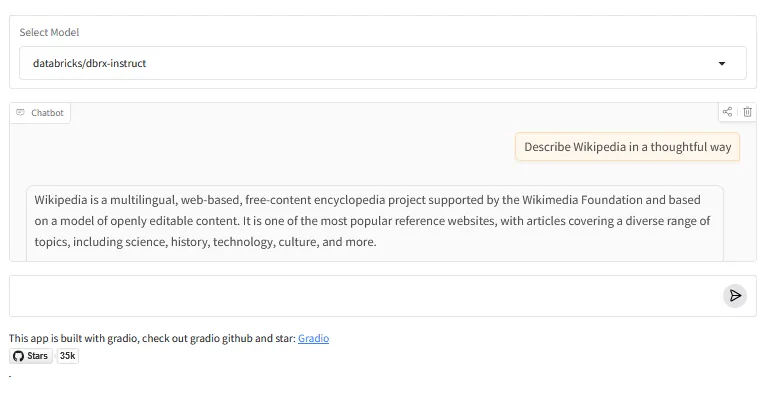
Photo: Software: Databricks and Gradio Screenshot: VulcanSphere, Public domain, via Wikimedia Commons
For two decades, the search marketer's unit of account was the link. You tracked positions, impressions, and clicks, and the dashboard told a coherent story. That story is now incomplete. A growing share of US purchase research happens inside AI-generated answers, where the reader may never click a result and where the visible reward is not a ranking but a citation—or worse, the absence of one.
The practical question is not whether AI answers matter. It is whether your brand is being quoted when buyers ask the questions your product answers. Most organizations cannot answer that question, because nobody has built the scoreboard.
Start With a Fixed Prompt Set
Citation auditing begins with a repeatable set of questions, not with ad hoc curiosity. Assemble forty to sixty prompts that reflect real commercial intent in your category: comparative questions ("best X for small businesses"), definitional questions ("what does Y actually cost"), problem-first questions ("how do I fix Z"), and brand-adjacent questions ("is [your brand] good for ...").
Draw them from three sources: your site search log, your sales team's most common objections, and the People Also Ask boxes on your priority keywords. Freeze the set. If the prompts change every month, the trend line means nothing. Add new prompts on a quarterly cadence and keep the original list intact so longitudinal comparisons remain valid.
Log the Answers, Not Just the Links
For each prompt, record four fields: whether your brand appears in the answer, whether it is cited as a source with a link, which domains are cited instead, and how the answer describes your category. Run every prompt against the two or three AI surfaces your audience actually uses, since citation behavior differs meaningfully between them.
Two summary metrics make the audit legible to leadership. Citation share is the percentage of prompts where your domain appears as a cited source. Mention share is the percentage where your brand is named even without a link. The gap between the two is diagnostic: high mention share with low citation share means the model knows your name but prefers other sources for evidence.
Read the Pattern, Not the Individual Answer
A single answer that omits you is noise—models are stochastic and answers vary between runs. Run each prompt three times and treat a recurring omission as a signal. Then examine the cited domains collectively. Are they review aggregators, trade publications, forums, government sites, or competitors' documentation? That distribution tells you where the model believes authority lives in your category, which is the map you need.
Diagnose the Entity Gap Before Rewriting Content
When your domain is consistently absent, the cause is usually one of four things, and they require different fixes.
Entity ambiguity. The model may not connect your brand name to the category, the product, or the geographic market you serve. Remedy this with consistent naming across the site, an About page that states plainly what the company does and where, and corroborating profiles on the directories and platforms the model already cites.
Missing structured data. Organization, Product, FAQ, and Article markup do not guarantee citation, but they reduce the interpretive work a system must do. Inconsistent markup across templates is worse than none.
Unquotable content. Answers favor passages that state a fact, a number, or a definition in a self-contained sentence or two. Long narrative introductions with the actual answer buried in paragraph six are structurally hostile to extraction. Lead with the claim, then support it.
Thin corroboration. Models frequently cite third-party sources for claims that a brand makes only about itself. If your pricing benchmarks, methodology, or survey data appear nowhere but your own blog, expect competitors' pages to be quoted instead. Publish original data and make it easy for others to reference.
Fix the Source Signals, Not Just the Page
Citation authority is partly off-site. Update the profiles that models appear to trust: industry directories, review platforms, trade association listings, Wikipedia-adjacent references where legitimately available, and credible press coverage. Ensure names, addresses, and descriptions match across all of them. Inconsistency is interpreted as uncertainty, and uncertain entities get omitted.
On-site, add a short, plainly written summary block to your most commercially important pages—what the product is, who it serves, what it costs, and how it differs. Keep the marketing language out of that block. It exists to be extracted.
Build a Monthly Routine
A citation audit earns its keep only as a habit. A workable cadence: run the frozen prompt set on the first business day of the month, log results in a shared sheet with a named owner, review citation share and mention share against the prior three months, and assign no more than three corrective actions. More than three and nothing gets done. Quarterly, add new prompts and retire the ones that no longer reflect customer language.
What the Scoreboard Changes
Once you can see citation share, budget conversations change. You stop arguing about whether a content refresh is worthwhile and start asking which prompts you are losing and to whom. You notice that a competitor is being quoted for a question your product answers better. You discover that a trade publication you have never engaged is the single most cited source in your category.
That is the value of the audit. It converts an opaque channel into a measurable one, and it gives the organization something it rarely has in AI search: a baseline, a trend, and a defensible reason to act.